Let’s have a tough conversation

Let's have a tough conversation

We’ve all been there. Uncomfortable silences, glaring issues that everyone knows about but no one wants to talk about, the proverbial ‘elephant in the room’. As humans, we naturally avoid conflicts. We would rather ignore the issue or get lost behind our screens, coding away, or jump into another meeting. The problem, however, continues to … Read more

Help, my Scrum Teams have become self-managing

Help, my Scrum Teams have become self-managing

As a diligent and incisive Scrum Master, your hard work in fostering self-managing Scrum Teams has finally paid off! These teams, thriving in autonomy, show a high level of engagement which correlates with improved productivity and innovative solutions. They are responsible for their work, make crucial decisions, and resolve challenges independently. However, you may now … Read more

What does servant leadership mean?

Servant Leadership

Servant leadership is an innovative approach that contrasts traditional leadership styles. It emphasizes empathy, listening, and placing others’ needs before one’s own. We see the importance of servant leadership, especially in Agile and the Scrum framework. In this article, I explore how managers can apply servant leadership and why it’s a vital tool in today’s … Read more

Making metrics matter: what can we measure in a Scrum team?

Scrum team metrics

In agile development, metrics carry real weight. They shape what teams pay attention to, how managers decide what “progress” looks like, and whether the Sprint Review ends in a genuine conversation or a defensive performance. Get the metrics right and they become a lens for improvement. Get them wrong, and they become ammunition. This post … Read more

Do It Yourself, Dammit: impediments and self-management

Do It Yourself, Dammit: impediments and self-management

The Scrum Master has two important roles: to remove impediments that are blocking the team’s progress, and to coach the team in becoming self-managing. While these roles may seem contradictory, they are actually complementary and interconnected. As a Scrum Master, you’re kind of like a parent to your Scrum Team. Your primary job is to … Read more

When a Scrum Master evolves into an agile leader

When a Scrum Master evolves to an agile leader

My employer announced my promotion to the company’s middle management at the beginning of this year. So, as a member of middle management, does a Scrum Master ‘manage’ others? Gunther Verheyen explains in this 2014 article that the Scrum Master role is not a management role, but rather a facilitation role. The Scrum Master is … Read more

“Coaching Agile Teams” by Lyssa Adkins: a review

"Coaching Agile Teams" by Lyssa Adkins: a review

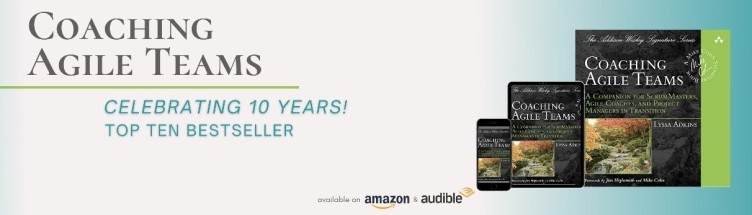
This article is a review of “Coaching Agile Teams” by Lyssa Adkins. I have based this review on a Dutch translation of the book.  “Coaching Agile Teams” by Lyssa Adkins is a well-regarded book on the subject of coaching agile teams and is recommended reading for those interested in the topic. The book provides practical … Read more

Facilitating an awesome Daily Scrum

Facilitating awesome Daily Scrums

The Daily Scrum is an important Scrum event. It is a daily meeting in which the Developers discuss their progress, identify any roadblocks and plan for the next 24 hours. The Scrum Master is critical in facilitating this meeting and ensuring that it runs smoothly and efficiently. Creating an environment conducive to open and honest … Read more

The Power of Timeboxing

The Power of Timeboxing

Timeboxing is an important aspect of Scrum, and it entails allocating a specific amount of time for each Scrum event, such as Sprint Planning, Daily Scrum, Sprint Review, and Sprint Retrospective. The Scrum Team is able to stay focused and on track by setting a time limit, ensuring that each event is efficient and productive. … Read more

Gamification in Scrum: setting up guidelines

Gamification in Scrum: providing a toolbox

In an earlier post, I discussed the possibility of incorporating gamification elements into Scrum. Gamification in Scrum has the potential to increase engagement, motivation, and collaboration. Incorporating game mechanics and elements can help to foster a culture of continuous improvement and experimentation. By utilizing game design elements such as point systems, leaderboards, challenges, competitions, clear … Read more