
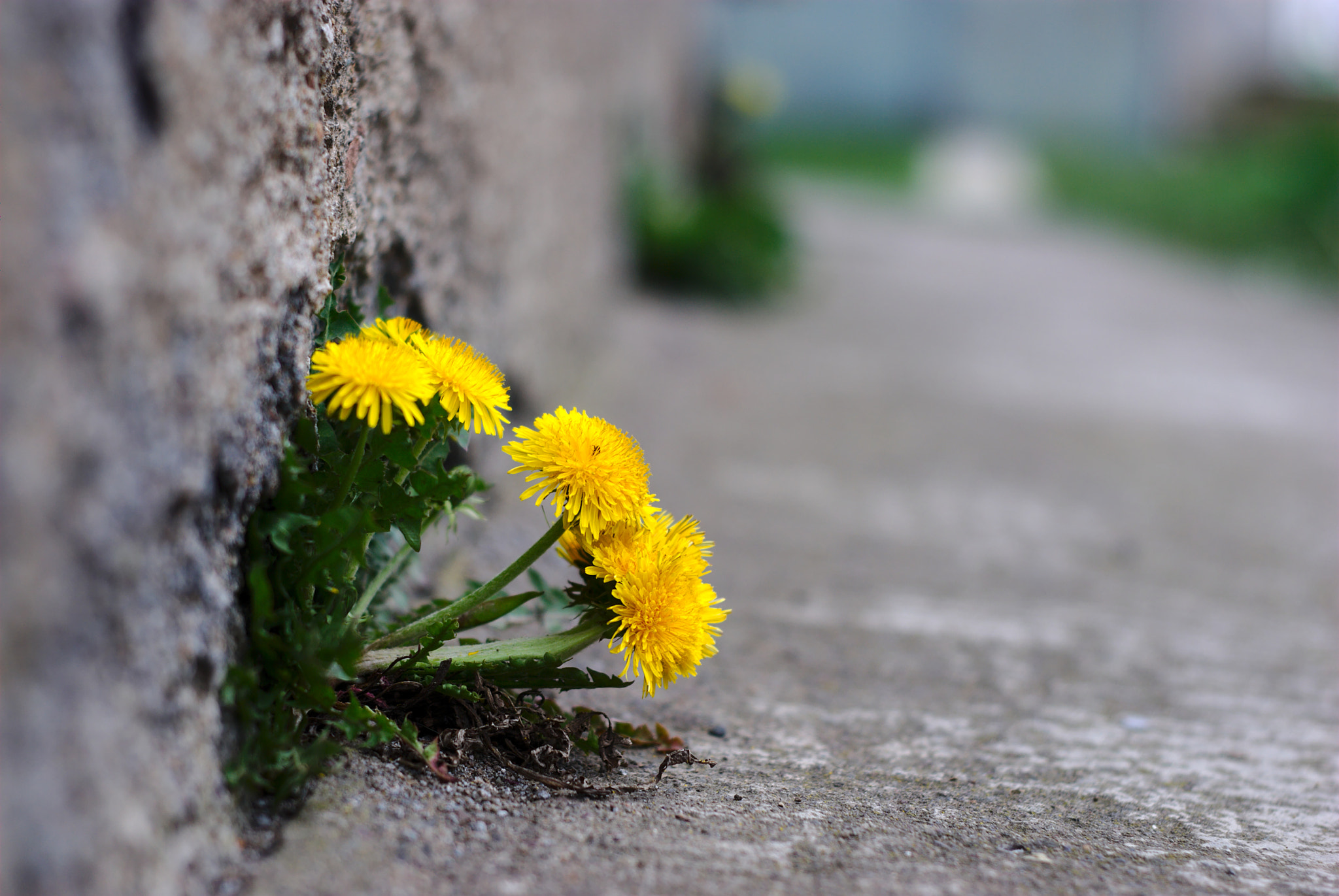
Resilience is in the smallest of things. I live next to a busy road. There’s a small crack in the concrete. It’s barely wide enough to notice, and yet a dandelion has pushed through it.
No one planted it. No one watered it. The conditions are, by any reasonable measure, hostile. And still, life found a way…
The dandelion reveals an uncomfortable truth about the modern working world: stability is not guaranteed. We can build plans, roadmaps, quarterly targets, org charts, and rituals that reassure us. We can pour more concrete. But the world does not owe us predictability, and it never will.

In the last few years alone, we watched a pandemic rewrite the rules of daily life. We watched technology go from “interesting” to “existential” in the span of product cycles. We observed supply chains collapsing, markets fluctuating, and assumptions rapidly aging.
If you base your sense of security on the belief that the upcoming quarter will mirror the previous one, you are putting your foundation on shifting sands.
I want to make a practical claim: resilience is no longer a desirable character trait. It is an essential survival skill. This is not the inflexible, ‘push through’ version of resilience; this is the genuine, ‘hardcore’ version. Nature has been honing resilience for billions of years.
Nature does not ‘cope’ with change. Nature assumes change.
Resilience is not hardness
The first mistake we make when talking about resilience is treating it like hardness. We often commend those who endure hardships while maintaining their integrity. But in nature, rigidity is often a liability. When an oak refuses to yield in a hurricane, it ultimately breaks. The willow survives because it bends, then returns. Resilience is not stubbornness; it’s all about responsiveness.
A river meets a boulder and does not file a complaint. It does not freeze in frustration. It does not cling to its original plan. It diverts. It reshapes the terrain over time. In nature, ‘failure’ is rarely a moral verdict. It’s feedback, a signal, a prompt to reorganize.
Resilience by reorganization, not resistance
Consider the tardigrade, a microscopic creature that survives extremes that would kill most life forms. It survives by shifting into a radically different state, essentially changing how it operates until conditions improve. It doesn’t fight reality but rather adapts to it.
Consider mangroves, which thrive in salty, oxygen-poor, tidal environments where no tree ‘should’ thrive. They don’t succeed despite the harshness. They succeed because their entire design has evolved around it. Their tangled roots are solutions, visible above ground because the environment demands it.


This is the mindset shift that matters for people and teams: resilience is not resisting change but building the capacity to reorganize in response to it.
Training for weather, not waiting for a storm
Now, the obvious question: how does one build that capacity for resilience without turning your life or your workplace into a constant emergency? You don’t wait for the storm to hit. You train for the weather.
Most teams start life like greenhouse seedlings. Protected, polite, carefully managed. Everyone is pleasant, and everyone is cautious. This type of behaviour is normal. It’s also brittle.
Tuckman gave us language for this: forming. It’s the phase where people are trying to be safe with each other. Then comes storming, the phase people try to skip. Disagreement surfaces, friction appears, and styles clash. The team confronts its inherent challenges. Said plainly: storming is a sign the team is becoming real.
In ecology, many forests need fire. Not a constant fire, not an all-destructive chaos, but periodic, ‘cleansing’ burns that clear deadwood, return nutrients to the soil, and open the canopy for new growth. Some plants even require heat to release seeds. Without the fire, the ecosystem accumulates fuel and becomes less healthy over time.
Teams work the same way. If you avoid the heat of honest conflict, you get artificial harmony. It feels calm, but it also hides rot. Decisions don’t get challenged. Risks don’t get named. People disengage quietly instead of disagreeing openly. You don’t remove conflict. You just push it underground, where it becomes sabotage, cynicism, and slow entropy. Resilience requires a team that can metabolize friction. You do not become resilient by staying comfortable. You become resilient by learning to move through discomfort without breaking relationships.
That movement through storming is what enables norming, the stage when the team stops pretending and starts building real agreements. Then, performing, where adaptation becomes almost instinctive: the team notices change quickly, discusses it without drama, and adjusts together.
Roots before results
There’s a condition for all of this. A storm-tested team is not built on process alone, but also on roots.
Lencioni’s model is often drawn like a pyramid, but I prefer to imagine it as a root system. Results are what people see above ground. The roots are what keep the organism upright when conditions change.
At the base is trust (specifically, vulnerability-based trust). It’s not simply a matter of “I trust you to deliver your tickets.” The deeper kind: “I can admit I don’t know, I can say I’m stuck, I can ask for help, and you won’t use it against me.”
Without that, everything else becomes fragile. Fear of conflict follows, because why would you risk honest disagreement if it might cost you status or safety? Without conflict, you get shallow commitment because people ‘agree’ in the meeting and disagree outside of it. Without commitment, accountability becomes personal. Without accountability, results become just a slogan.
Commitment matters for resilience because disruption amplifies whatever is already true.
A team with shallow trust can look fine in calm weather. Then a key person leaves, the strategy pivots, the market shifts, or the roadmap collapses, and suddenly the team topples. It can be compared to a tall tree with shallow roots.
Even in the face of disruption, a team rooted in deep trust manages to bend rather than break. It argues more openly and frequently. It asks for help faster. It recovers quicker. It can hold standards without turning them into blame, because accountability is anchored in shared commitment, not fear.
Resilience borrowed from nature
So, how do you build those roots in a way that feels tangible, not like a poster about psychological safety? You can literally borrow from nature.
Start with the practice of controlled stress. Gardeners harden off seedlings before moving them outside. They don’t throw a delicate plant into full wind and sun immediately. They introduce exposure gradually so the plant builds tolerance. Without that, a seedling that looks healthy indoors can wilt the moment reality arrives.
Teams need the same approach. Instead of creating artificial drama, teams should intentionally and manageably confront challenges.
This can be achieved by conducting a low-stakes ‘incident simulation‘ on a monthly basis, which simulates a scenario where something breaks, priorities collide, or a stakeholder modifies the objectives. Then you watch how the team responds, not to judge people, but to study reflexes. Do we freeze? Do we blame? Do we go silent? Do we swarm and communicate? You are training nervous systems, not just processes. You can see it like an evacuation drill.
It can look like choosing one retrospective per month where you do not talk about “what went well.” You talk about what hurt. The misalignment. The quiet resentment. The work continues to fall through the gaps. This is the controlled burn. You’re reducing fuel before it becomes an inferno.
Then there’s biodiversity, the quiet superpower of resilient ecosystems. Monocultures are efficient until they aren’t. One disease, one shift in conditions, and the whole field collapses. Diverse ecosystems absorb shocks because there are multiple ways for life to continue. Teams create monocultures when knowledge or influence concentrates too much. There is always one individual who is well-versed in the system. This individual possesses the ability to effectively communicate with clients. This individual possesses a comprehensive understanding of the release pipeline. It works, until that person gets sick, quits, or burns out.
The nature-inspired intervention is cross-pollination. Pairing across specialties. Rotating facilitation. Teaching, not hoarding. It will feel slower in the short term. It is faster in the long term because it prevents single points of failure (SPOFs).
If you want a surprisingly practical image here, take the ecotone: the edge where two ecosystems meet, like where a river meets the sea. These edges tend to be the most diverse and resilient zones. The overlap creates options. In teams, resilience is often born at edges too, where disciplines actually meet, not where they are cleanly separated. Put design next to engineering. Put operations next to the product. Let the boundary become a place of exchange rather than a wall.
Then there’s the most countercultural lesson of all: dormancy. In winter, many plants pull energy inward. They stop producing. They rest. No laziness, all strategy. Some species even require a cold period to bloom properly later.
Teams that never “winter” eventually freeze anyway. The body collects debt. The mind collects debt. The social fabric collects debt. If you do not schedule recovery, it arrives as burnout, conflict, and attrition. So after a hard release, a crisis, or a gruelling quarter, protect a small season with a lower intensity. This phase is not intended as a reward but rather as a form of maintenance. Make the recovery visible and legitimate. Resilience is not just how you endure stress. It’s how you restore capacity afterward.
The mycelium beneath the team
Lastly, let’s discuss the concept of the invisible network.
Forests have mycorrhizal networks, fungi connecting roots, moving nutrients, sending signals, and supporting weaker trees. Some call it the “wood-wide web.” It’s one of the reasons a forest is not just a bunch of trees standing near each other but rather part of a system.
Teams need their mycelium, an informal layer of check-ins, support, and early warning signals that sits beneath the formal ceremonies. Do people notice when someone is withdrawing? Can someone say “I’m not okay” without it becoming a career risk? Is there a mechanism for support before a person breaks?
This aspect is where resilience becomes ethical. If you define resilience as “toughening up,” you create harder individuals and colder teams. If you build resilience as “we support each other through weather,” you create capacity and loyalty.
Dandelions and sandworms
Back to the dandelion. It did not wait for perfect conditions; it did not require certainty. It sure as hell did not demand that reality become kinder. It just used what it had: a crack, a little water, and a sliver of light. And with that, it grew. That’s adaptation in its purest form.
The world is not going to slow down. Technology will keep shifting. Economies will keep surprising us. There will be other disruptions, other moments where yesterday’s playbook becomes useless overnight. Anticipating the unexpected is not a sign of pessimism; it is a fundamental aspect of life.
There’s a recurring idea in science fiction (such as in Frank Herbert’s Dune series) that sometimes a civilization has to pass through disruption to become fit for the future. You can hate the instability and still accept what it reveals. Comfort does not evolve us. Pressure does. The question is whether we let pressure fracture us or whether we use it to reorganize into something more capable. And in teams, that ‘reorganization’ is trust that allows conflict to be useful and standards that prevent stress from turning into blame.
Resilience is something you build. It’s a capacity you build. A muscle, a root system. It grows with deliberate exposure, honest conflict, real recovery, and the quiet networks of support that make a team more than a collection of individuals.