Most days, you would have no trouble spotting me. A tattoo emblazons my chest and peeks out over my collar. Thick silver hoops in both ears. All black, leather suspenders, a bald head and a big beard. I have been told, affectionately, that I look like a queer villain, somewhere between a Star Wars bad guy and General Zod (the late Terence Stamp’s version, of course), only a good deal more fruity.

Among the colleagues I know and love, this is simply what I look like and how I am. High energy, a bit extra, the jokes are dry and full of innuendo. Nobody flinches. Nobody asks me to turn it down.
And yet. Put me in a room where I’ve decided, in advance, that I need to make a good impression, a first meeting with a client or a prospect, when the stakes of leaving a ‘great’ impression are high, and something quiet starts up inside me. The earrings come out before I leave the house. The volume drops on everything that makes me recognizable. So today on the ides of June, in Pride month, I want to sit with one uncomfortable question, and I want to put it to you too: how much are you your unapologetic self?
They could not find me
Not long ago I was in a high-stakes situation where I badly wanted to land well, and I didn’t fully show up. I took the earrings out, buttoned up the shirt, and dialled down the extra. I answered from my head, the way you answer a question you’ve rehearsed in the mirror. Afterwards, I was confronted with it, gently and almost apologetically. They hadn’t been able to connect, hadn’t “met me”. They had met a curated version wearing my face. It was a very specific kind of feedback, the one they hand out on RuPaul’s Drag Race when a queen turns it out technically but the judges still can’t find her under the polish. Too edited. Too in her head. Beautiful, and somehow nobody home.
That confrontation is what started all of this thinking. I make rooms feel safe for a living. I take the friction out before it lands on anyone. I have built a whole professional identity on the idea that genuine welcome is rigorous, structural work and not soft-skills decoration. But what did I do? I read the room, anticipated where someone might have to do a little work to place me (the queer thing, the metal in my ears), and sanded it away before they ever had to.
It’s not from a place of shame, though. Shame is the easy story, and it ain’t mine. I just didn’t want to become a topic.
That is hostmanship pointed in exactly the wrong direction. The coach is the instrument, and a self you have sanded smooth is a blunt one. Jan Gunnarsson describes three stages of hostmanship: welcoming others, welcoming each other, and welcoming yourself. The third, he says, is where the other two come from. And I had failed the third stage of my own.
No one ever asked me to tone down
This is the crux. No one in that situation asked me to take the earrings out and button up the tattoo. No one ever has. There was no raised eyebrow, no rule on a wall. The self-redaction was entirely my own work, performed in advance, against a threat that wasn’t even in the room.
Kenji Yoshino has a word for it in covering. Covering is the quiet pressure to mute a known, disfavored part of yourself so you slide more smoothly into the mainstream. His sharpest point is that the pressure outlives the open hostility that first created it. The hostility goes, the reflex stays.
And I know it is the room and not me, because I have felt the opposite. Recently I sat in a room that felt genuinely, unmistakably safe; the whole of me turned up without my deciding anything. I didn’t perform competence. I was competent and queer and a bit much, all at once, and nobody had to go looking for the person, because the person was right there. The armour doesn’t clamp shut when I feel unsafe. It clamps shut when I feel measured. Which is its own small joke, because psychological safety, the belief that you won’t be punished for showing up honestly, is the very thing I sell. I withdrew it from myself the moment I felt assessed.
Fear is back on the menu
Let me check my privilege, plainly. I am a cis man. I am situated in one of the safest corners of the world for someone like me. If the reflex fires this hard in me, with all that padding, imagine how loudly it fires in people who have far less of it and far more reason to be careful.
For years I treated my own armour as a personal quirk, leftover wiring from a younger self who genuinely needed it. I can’t file it under personal history anymore. The world has started moving in a direction I didn’t expect to see again. We told ourselves we’d come so far, and in a lot of places that progress is now being unpicked, slowly and then less slowly. Fear, the thing we were assured was behind us, is back on the menu.
So here is the question I cannot duck. Yes, I speak from privilege. But does that not give me an obligation rather than an excuse? If I can be fully myself at a lower cost than almost anyone (provided it’s safe – safety first ofcourse!), do I not owe it to everyone who cannot to actually do it? Every time one of us shrinks to order, the ceiling drops a little for whoever comes next. Stay whole, and it lifts. I would rather be someone who lifts it. I would rather not let bigots win by doing their work for them, quietly, in advance.
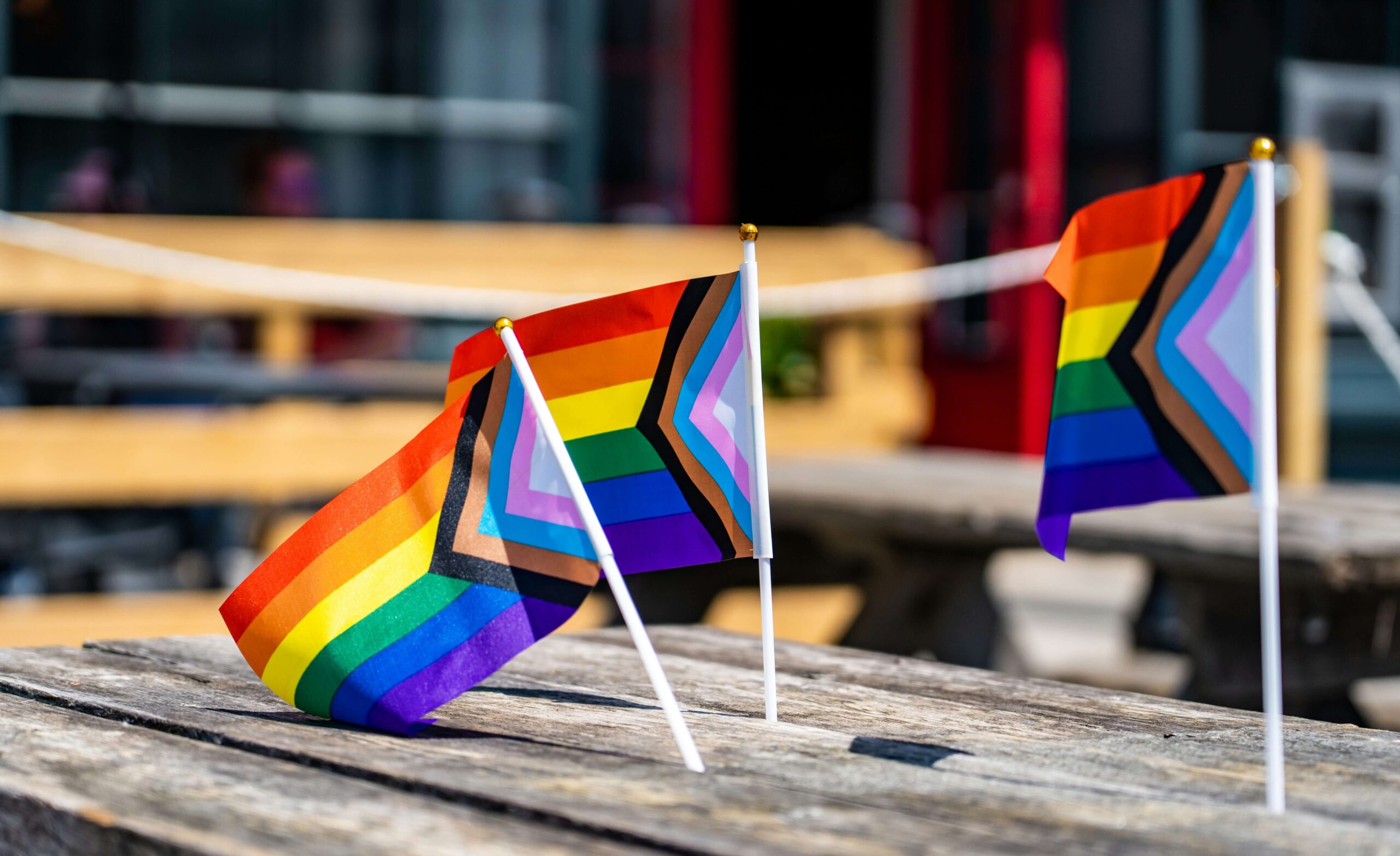
Visibility takes courage. But that is what Pride is, right? The courage to be seen, so that being seen costs the next person a little less.
The coach goes first
A coach’s presence is not a decoration around the job. It is the job. Carl Rogers worked this out decades ago. Alongside empathy and unconditional positive regard, he named congruence, being genuinely yourself, as a condition without which a helping relationship simply doesn’t take hold. Also: incongruence leaks. A client feels a performed self even when they can’t name what is off. They could not find the person. Rogers could have told them why.
Brené Brown calls it going first. The one who shows up whole gives everyone else permission to. You set the waterline, and whatever you are willing to show is the ceiling on what anyone else will risk. You can’t ask a team to bring their unpolished selves into the room while you sit there in full armour.
And if a prospect can’t warm to who I actually am, then it was never going to work anyway. Better to learn that than to win the room as someone I would then have to keep being. So I am staying more true to who I am. Not because the world turned safe (it didn’t) but because erasing myself costs me more than the risk ever did, and because for a coach it isn’t even really a choice. Being your unapologetic self is the instrument staying sharp.
Honesty demands a caveat. This can cost you. Not every closed door is bigotry. Sometimes it is just a hiring manager who found you a bit much, and the impression cannot be walked back. Visibility is not free, and for a lot of people the bill is rent, healthcare, a livelihood. Sometimes, reeling yourself in would feel like the safest option.
So I will hand you the question I have been carrying, now that it is Pride month and the air feels the way it does.
How much are you your unapologetic self in the rooms where it counts?
And what would it actually cost you to bring a little more of yourself into the next one?
Bring the whole self. Be a little more fearless than feels comfortable. Don’t let anyone talk you into doing their shrinking for them.
And whatever you are, wherever you are reading this from. Happy Pride!